If you're a Muslim parent, the question of whether Peppa Pig is okay for your kids to watch has probably crossed your mind. It’s a common conversation, and it boils down to one central point: the main character is a pig, an animal with specific prohibitions in Islam. This creates a real point of tension for families trying to balance modern media with faith-based values.
This guide is designed to walk you through the nuances, helping you make a choice that feels right for your family.
The Peppa Pig Question for Muslim Families
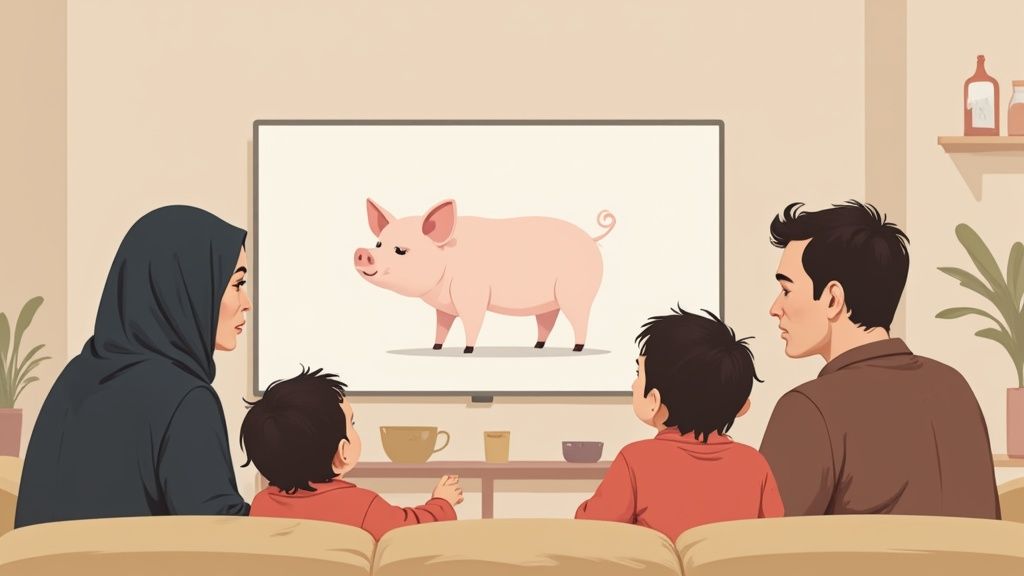
For many Muslim parents, letting a toddler watch Peppa Pig isn't a simple yes or no. The heart of the issue is that the star of the show is a pig, an animal considered impure (najis) in Islam, with its consumption being strictly forbidden. While the Quranic prohibition is about eating pork, the constant, positive portrayal of a pig character can feel awkward for parents trying to instill Islamic principles from day one.
This has led to a wide spectrum of views within the Muslim community. On one end, you have parents who steer clear of the show completely. They worry that making a pig a friendly, lovable character might unintentionally downplay important religious teachings later on.
On the other end, many parents see it as harmless fiction, totally separate from dietary laws. They focus on the show's simple lessons about family, friendship, and kindness, which align well with universal values.
Global Reach and Community Discussions
Peppa Pig's incredible popularity has turned this from a small household dilemma into a global conversation. The show is broadcast in over 180 countries, making it almost impossible to avoid.
This widespread presence has sparked serious discussions in Muslim communities everywhere. In Australia, for instance, some Islamic leaders have even called for creating faith-aligned alternatives, signaling a growing desire for children's media that reflects a Muslim upbringing. You can read more about the call for Muslim alternatives to Peppa Pig.
To help clarify these points, here’s a quick-reference table summarizing the main considerations.
Quick Reference for Muslim Parents on Peppa Pig
| Topic of Consideration | Summary of Nuance for Muslim Parents |
|---|---|
| The Pig Character | The central issue. While the prohibition is on consumption, the positive portrayal of an animal deemed impure (najis) can be uncomfortable for some families. |
| Behavioral Modeling | Peppa's character is sometimes seen as rude or disrespectful to her parents, which can conflict with Islamic teachings on honoring elders. |
| Educational Value | The show teaches simple concepts like family, friendship, and cooperation. Many parents feel these positive themes outweigh other concerns. |
| Community Consensus | There is no single Islamic ruling on the show. Opinions vary widely, from strict avoidance to viewing it as harmless entertainment. |
Ultimately, this table shows that the "right" choice depends entirely on your family's values and comfort level.
At its core, the debate over Peppa Pig isn't just about a cartoon. It's a perfect example of a bigger challenge for modern Muslim parents: how do we thoughtfully navigate mainstream culture while nurturing a strong religious identity in our children?
There’s no one-size-fits-all answer. Every family arrives at its own conclusion based on their personal interpretations, cultural background, and unique parenting style.
A Content Analysis for Toddlers and Preschoolers
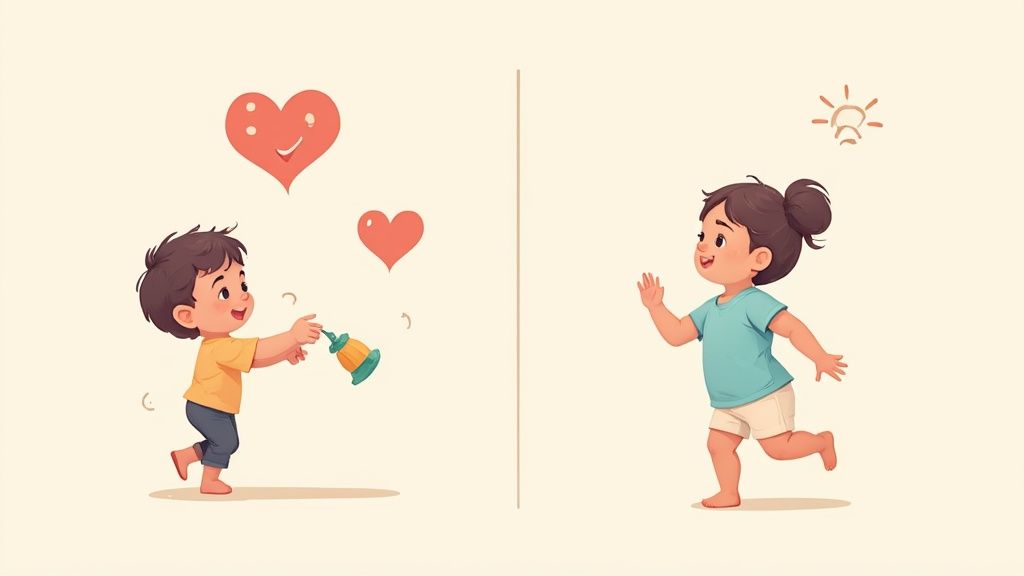
Putting aside the symbolism of the main character for a moment, it’s worth taking a closer look at the show's actual content. For peppa pig muslim parents, analyzing Peppa Pig through both a developmental and an Islamic lens reveals a real mix of positive messages and potentially tricky behaviors for young, absorbent minds.
On one hand, the show does a great job of showcasing strong family bonds. Mummy Pig, Daddy Pig, Peppa, and George are always doing things together, whether it's visiting grandparents or just playing in the park. This focus on family togetherness is a value that resonates deeply with Islamic principles. The language is also simple and repetitive, which is fantastic for language development in the 0–3 age group.
On the other hand, many parents have raised valid concerns about the behavior modeled in the show. Peppa herself often comes across as sassy, and she frequently speaks to her parents in a way that could easily be seen as disrespectful. For instance, she regularly calls her father "silly Daddy," a comment that’s usually met with a laugh track instead of gentle correction. This can be a tough pill to swallow for families who are trying to instill adab (good manners) and respect for elders from day one.
Identifying Key Themes for Discussion
To make a decision that feels right for your family, it helps to break down the show's content into specific themes and weigh them against your own values.
- Obedience and Respect: You’ll notice that Peppa questioning or even defying her parents is a common theme used to drive the plot. While it’s meant to be funny, it might also normalize behaviors that you’re actively trying to discourage at home.
- Emotional Expression: The show does a decent job of portraying basic emotions like happiness, sadness, and frustration in a way toddlers can grasp. The only catch is that Peppa’s tantrums or jealous outbursts aren't always wrapped up with a clear moral lesson.
- Friendship and Sharing: Many episodes are about Peppa playing with her friends, offering simple lessons on how to share and cooperate. These moments can be genuinely positive examples of social skills in action.
The real challenge for parents is figuring out how to separate the good stuff—like the simple stories and sound recognition—from the behavioral examples that might clash with an Islamic upbringing. For a look at how to approach this kind of educational screen time, our guide on teaching animal sounds for toddlers might offer some useful ideas.
At the end of the day, this isn't about slapping a "good" or "bad" label on the show. It's about giving you the tools to critically evaluate its content against the values you want to pass on to your child. This way, you can decide if Peppa Pig's overall message is one you feel comfortable welcoming into your home.
Navigating Community and Family Perspectives
Deciding what your toddler watches feels like it should be a simple, personal choice. But for many Muslim parents considering Peppa Pig, that decision doesn't happen in a bubble. It often means navigating a tangled web of opinions from family, friends, and the wider community, turning a cartoon into a surprising source of social pressure.
This pressure comes from the simple fact that there’s no single, universally accepted Muslim stance on the show. You’ll find strong opinions on all sides. Some community members will be adamant that any exposure to pig imagery is a non-starter. Others will see it as harmless fiction, a silly cartoon and nothing more. This can leave you feeling confused or even guilty, no matter which path you choose for your own family.
Balancing Different Generational Views
The conversation gets even trickier when family is involved, especially with the older generation. Grandparents, for example, might voice serious discomfort about their grandchildren watching a show starring a pig. Their views are often shaped by deeply ingrained cultural sensitivities that are hard to separate from religious teachings.
This can put you in a tough spot. You want to respect your elders, but you also need to make choices that feel right for your own kids in the world they're growing up in. The key is to acknowledge their concerns with real empathy while being able to gently explain your own reasoning.
The truth is, countless families are having this exact same struggle, often quietly. It's a very common feeling to be caught between honoring tradition and raising kids in a modern, multicultural environment.
For instance, one British Muslim mother talked about how she and her friends let their kids watch Peppa Pig but feel a sense of judgment from more conservative peers who worry about the show's hidden messages. This really shines a light on the delicate balance Muslim families navigate every single day. You can read more about these parental experiences on Hyphen Online.
Strategies for Confident Decision-Making
To handle these conversations without all the stress, it really helps to get clear on your own "why." When you understand your own reasons for allowing or disallowing the show, you have a solid foundation for any discussion that comes your way.
Here are a few practical strategies:
- Define Your Family's Stance: Get on the same page with your spouse about your household's approach. Presenting a united front makes it much easier to communicate your choice to others.
- Listen Respectfully: When a family member shares a concern, just listen. Try not to get defensive. You can validate their feelings by saying something as simple as, "I understand why you feel that way."
- Explain Your Perspective Calmly: Frame your decision in the context of your own parenting philosophy. You could say, "We've thought about it and decided to focus on the show's lessons about family and friendship."
At the end of the day, the goal is to feel confident in the choices you make for your own children, without carrying the weight of external judgment. Every family’s journey in balancing faith, culture, and modern life looks a little different, and that's perfectly okay.
Actionable Strategies for Co-Viewing Peppa Pig
So, you've decided that Peppa Pig can have a place in your home, but you want to make sure it's a positive one. The secret isn't just letting your child watch; it's about shifting from passive screen time to active, mindful engagement. Instead of using the show as a babysitter, you can turn it into a genuine teaching opportunity.
This is often called co-viewing, and it's a game-changer. By simply watching with your child, you're right there to frame the narrative. You can provide immediate context for any scenes that might not align with Islamic manners (adab), turning what was a one-way screen monologue into a rich dialogue between you and your little one.
Set Clear and Consistent Limits
Before the show even starts, it's crucial to set the ground rules. Toddlers do best with routine, and having consistent limits around screen time can head off a lot of future arguments. Letting them watch indefinitely often leads to them feeling overstimulated, making it much harder to switch gears to another activity when you need them to.
Decide ahead of time how much is enough—maybe one or two episodes—and stick to that rule. A visual timer can be a toddler's best friend in these situations; it helps them see when time is running out, so it doesn't feel like an abrupt or arbitrary punishment.
Use the Show as a Conversation Starter
This is where the real magic of co-viewing happens. You have the power to hit pause and talk about what's unfolding on the screen, creating a direct link between the cartoon's world and your family's principles. For many Peppa Pig Muslim parents, this is the single most effective way to navigate the show.
Here are a few ways this could look in practice:
- If Peppa is disrespectful to Daddy Pig: Pause and gently ask, "Hmm, that wasn't a very kind way to talk. How does Allah teach us to speak to our parents?"
- When a character shares a toy: You could praise the action with, "Masha'Allah, look at Suzy Sheep being a good friend! Sharing is a sunnah of our Prophet (PBUH)."
- During a scene about helping others: Point it out by saying, "Look how Peppa is helping Mummy Pig. Helping our family makes Allah happy, doesn't it?"
These aren't meant to be long, drawn-out lectures. They're quick, teachable moments that place the content within an Islamic framework. You're essentially turning a simple cartoon into a dynamic learning tool. For other hands-on ways to build on these lessons, see our guide on what flash cards are and how they can reinforce these concepts away from the screen.
By being an active participant, you make sure that your values—not the cartoon's—are what really stick.
Faith-Aligned Cartoon Alternatives for Young Children
For families looking for content that more actively supports an Islamic worldview, there's a growing world of fantastic, high-quality cartoons to explore. These shows aren't just about avoiding problematic themes; they were created by Muslims, for Muslims, to help build a positive Islamic identity right from the start.
Instead of having to watch mainstream shows and constantly explain why certain behaviors aren't okay, these alternatives give peppa pig muslim parents a truly proactive choice. They weave core concepts like adab (Islamic manners), love for Allah, and stories of the Prophets directly into fun, engaging narratives that toddlers can actually understand and enjoy.
Whether you're co-viewing a mainstream show or an Islamic one, the principles of mindful viewing still apply. This simple framework is a great reminder.
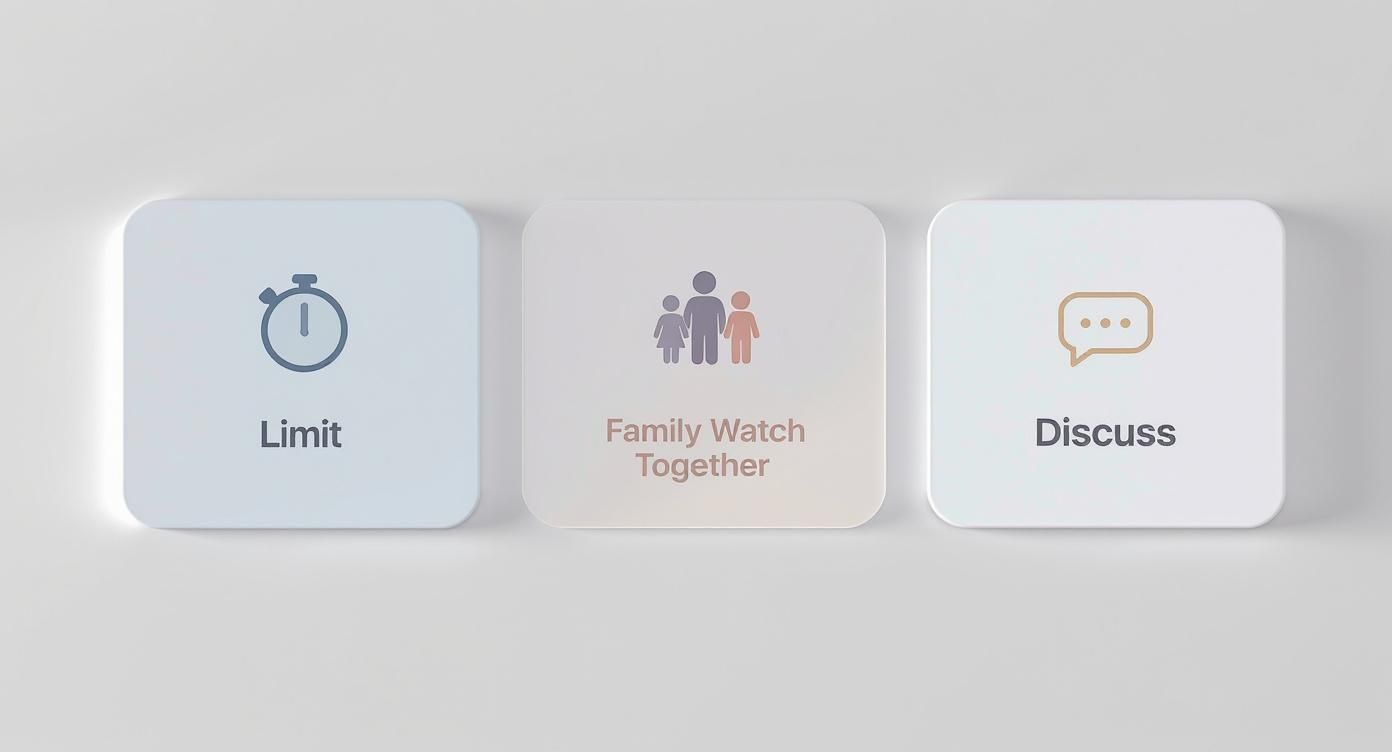
As the visual shows, it’s all about setting clear boundaries, being present with your child, and using what you watch as a springboard for conversations about your family's values.
Top Islamic Cartoons for Toddlers
Diving into these shows can open up a whole new library of beneficial screen time for your little one. Each one has a slightly different flavor, so you can easily find something that clicks with your child's personality and what you want to emphasize as a family.
- Barakah Hills: This show is often called the "Muslim Peppa Pig" for a reason—it was created as a direct, wholesome alternative. It centers on the Abdullah family and their life in a small Muslim town, modeling beautiful manners, kindness between siblings, and community spirit.
- Omar & Hana: If your child loves music, they'll adore this one. A super popular Malaysian animation, it's famous for its incredibly catchy, instrument-free nasheeds that teach kids about the Prophets, daily duas, and the basics of Salah in a way they won't forget.
- Zaky & Friends: One of the originals in this space, Zaky is a lovable purple bear who has been teaching kids for years. Through gentle stories and songs, he introduces the Arabic alphabet, stories from the Quran, and foundational Islamic principles.
To help you get a quick sense of what's out there, here’s a simple comparison of some popular choices.
Comparison of Faith-Aligned Cartoon Alternatives
| Show Title | Core Focus | Target Age | Key Values Taught |
|---|---|---|---|
| Barakah Hills | Everyday life & social etiquette (adab) | 2–5 | Kindness, honesty, helping others, family |
| Omar & Hana | Islamic concepts through songs (nasheeds) | 1–6 | Love for Allah & Prophet Muhammad (PBUH), duas |
| Zaky & Friends | Foundational Islamic knowledge | 2–6 | Arabic alphabet, stories of the Prophets, pillars of Islam |
| Ali and Sumaya | Quranic stories & moral lessons | 3–7 | Courage, faith, patience, stories from the Quran |
Each of these shows offers a unique way to bring Islamic teachings to life, making them a great addition to your child’s media library.
Platforms Offering Curated Content
Beyond just hunting for individual shows, some platforms do the curating for you, creating a completely safe viewing space. Babymode, for example, is designed specifically for the 0–3 age group, offering AI-generated, ad-free videos that are all reviewed for Islamic educational guidance.
The platform provides stories that are not just entertaining but also enriching. For instance, our look into ABC stories in American Sign Language shows how learning can be inclusive and cover multiple developmental areas at once. Services like this give parents real peace of mind, getting rid of unpredictable algorithms and ads to ensure everything your child watches is nurturing and faith-centered.
Creating a Healthy Digital Environment for Your Child
Deciding what your child watches is just one piece of the puzzle. The real goal is to build a healthy digital environment from the ground up, one where you have peace of mind about what they’re seeing and how they’re seeing it. This isn't just about modern safety tips; it's about applying the timeless Islamic principle of moderation and balance (wasatiyyah) to screen time.
Think of it less as restriction and more as thoughtful guidance. You’re creating a safe, nurturing space for your little one to explore. By managing screen time well, you ensure that media supports your family's values instead of undermining them. This approach also respects a toddler's most critical need: unstructured play and connection with the real world.
Fortunately, many of the streaming platforms we use every day have built-in tools to help us do exactly this. Using them effectively puts you back in the driver's seat.
Practical Steps for Digital Stewardship
Putting a few key technical controls in place can make an immediate difference. These tools are designed to give you granular control over what your child can access, helping you align their digital world with your family’s principles.
Here are a few actionable steps you can take today:
- Create Child-Safe Profiles: Nearly every major streaming service, including Netflix and YouTube Kids, lets you create a specific profile for your child. This instantly filters out mature content based on age ratings, effectively creating a walled garden of appropriate shows.
- Use Parental Controls to Block Shows: You can go one step further. If you've decided Peppa Pig just isn't the right fit for your family, most services allow you to block specific shows or channels entirely, even from within a kids' profile.
- Review App Permissions: Always be mindful of the apps your child uses on a tablet or phone. Take a moment to review their privacy settings and permissions. Many apps, even those for children, are designed to collect data. Choosing services that respect privacy is a huge part of digital responsibility.
Responsible digital stewardship is an act of trust (amanah). We are entrusted with our children's well-being, and this extends to protecting their hearts and minds from inappropriate or overwhelming digital content.
By taking these simple steps, you're not just blocking a cartoon—you're building a digital framework that supports a healthy, balanced childhood. It allows your little one to enjoy the good parts of screen time without the risks, helping you raise a child who is both digitally aware and grounded in their faith.
Frequently Asked Questions for Muslim Parents
Choosing what our little ones watch can feel like a minefield. For Muslim parents trying to figure out if Peppa Pig is okay, the questions often mix typical parenting worries with very specific faith-based concerns. This section tackles some of the most common questions I hear from parents, offering clear, straightforward answers.
My aim here is to give you the clarity you need to make confident choices that feel right for your family and bring you a sense of peace.
Is It Haram to Watch Peppa Pig?
This is, without a doubt, the number one question. The short answer is that it's complicated because there is no single, definitive Islamic ruling that covers cartoons like this. Islamic scholars have a range of opinions on making and displaying images, especially of living things. The most conservative interpretations suggest avoiding all such imagery, which would naturally include shows like Peppa Pig.
On the other hand, many scholars make a distinction. They see a big difference between images made for worship and simple, fictional characters created for a child's entertainment. From this viewpoint, a cartoon pig—which no one is worshipping—doesn't fall under the stricter prohibitions. In the end, deciding whether your child watches is a personal matter of conscience (taqwa) based on which scholarly interpretation your family feels most comfortable with.
How Should I Talk to Family Who Disagree?
Navigating different opinions within the family, especially with grandparents or elders, can be really tough. If a relative voices their concerns, the best approach is always one of respect and calm communication. Try not to get defensive. Instead, really listen to what they're saying; it shows that you value their perspective, even if you don't agree.
After listening, you can gently explain your own thought process. You could say something like, "Jazakillah Khair for sharing that with us, we really appreciate your concern. We've thought a lot about it and decided that for our family, we'll watch it together so we can use it to talk about good manners." This frames your choice as a proactive parenting strategy, not a rejection of their values.
What If My Child Starts Snorting Like Peppa?
It's bound to happen! Toddlers are little sponges, and they love to mimic everything they see and hear. If your child suddenly starts snorting, the best thing you can do is not make a big deal out of it. A big reaction can sometimes turn it into a fun game and make them do it more.
Instead, gently and playfully redirect them. You might try, "That's a funny piggy sound! Can you show me how a lion roars?" This acknowledges their playfulness without turning the snorting into a point of contention. Trust me, it’s almost always a passing phase that will disappear as soon as they find a new, interesting sound to make.
For parents looking for a screen-time solution that sidesteps these issues altogether, Babymode provides a curated, faith-aligned viewing experience. Our platform was built specifically to offer halal, ad-free content for toddlers aged 0–3, with every piece of content reviewed for Islamic educational value. You can explore a safer, more enriching digital space for your child at https://babymode.ai.